The Ultimate Guide to AI Code Review Tools in 2026: Automate PR Quality with GitHub Copilot, CodeRabbit, and Qodo

📸 GitHub introduces AI testing "playground' GitHub Models ...
What Are AI Code Review Tools?
Code reviews are the quality gate for any development team. But in reality, PRs pile up, senior developers are overwhelmed, and review quality varies. In 2026, AI-powered code review tools are stepping in to solve this persistent challenge. From GitHub Copilot’s agent mode to CodeRabbit and Qodo Merge—discover how AI is transforming the code review workflow.

📸 GitHub AI · AI built into every step of your workflow · GitHub
🤖 Why Do We Need AI Code Reviews?
Developers spend only 20–40% of their working hours on actual coding (Bain & Company, 2025). The rest goes to meetings, documentation, and especially code reviews. In particular, code reviews:
- Consume 2–3 hours per day of senior engineers’ time
- Take 2–3 days on average to merge a PR
- Have inconsistent judgment standards across reviewers, leading to missed bugs
- Make security vulnerabilities hard to catch with manual inspection
AI code review tools automate these bottlenecks. They review code around the clock, 365 days a year, with consistent standards—catching bugs and security flaws that humans often overlook.
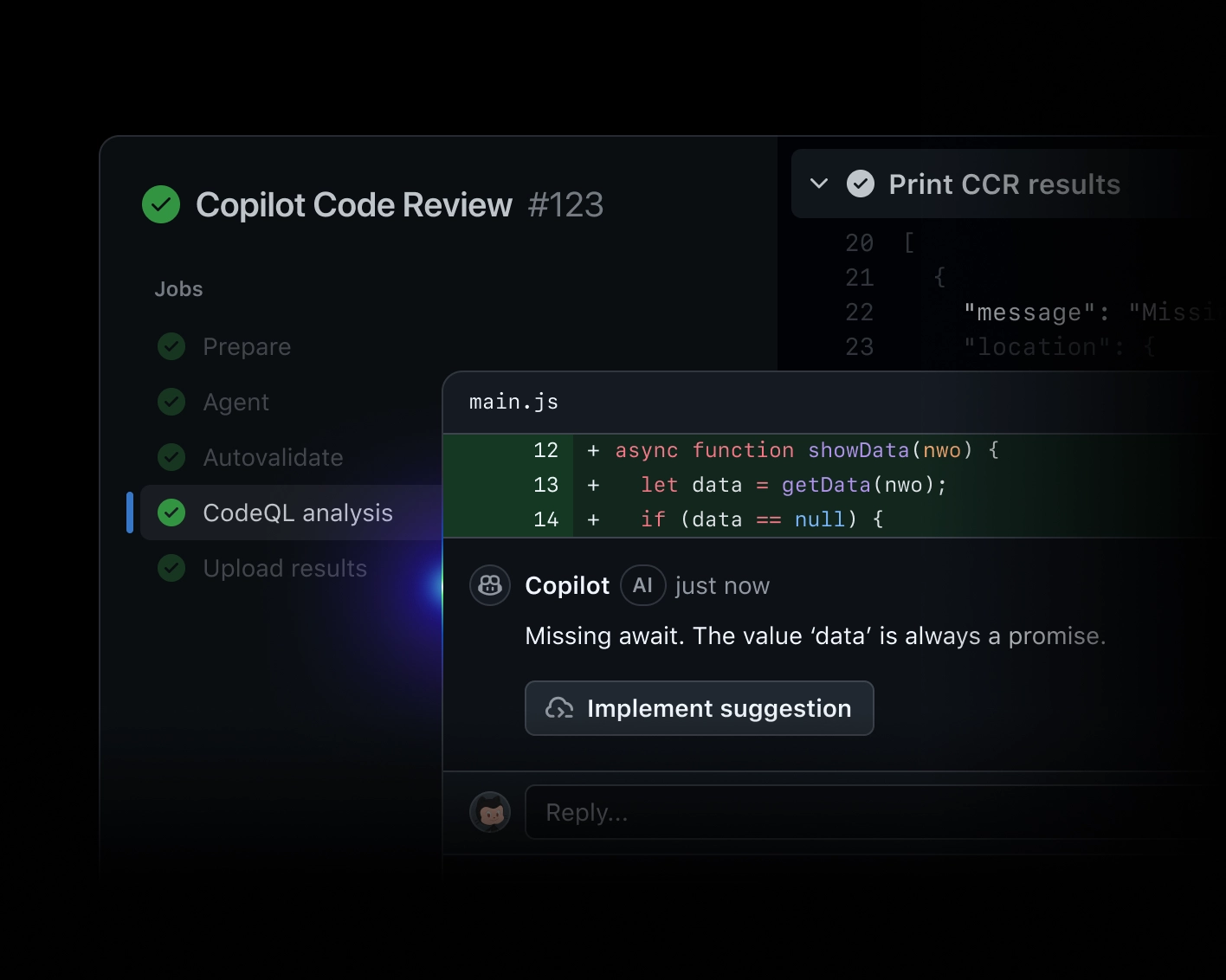
📸 GitHub AI · AI built into every step of your workflow · GitHub
🔧 Key AI Code Review Tools in 2026
📸 GitHub Copilot · GitHub
1. GitHub Copilot Code Review (Agent Mode)
In early 2026, GitHub launched a full agent mode for Copilot. Now it does more than code completion—it analyzes entire pull requests and automatically generates intelligent, actionable review comments.
- Automatic PR Summaries: Summarizes changes in natural language
- Bug Pattern Detection: Detects null pointers, race conditions, and memory leaks
- Fix Suggestions: Recommends code fixes on the fly when issues are found
- Issue-to-PR Automation: Turns GitHub issues into code and creates pull requests autonomously
# Example .github/copilot-instructions.md configuration
# Customize review rules
- Check for SQL injection vulnerabilities
- Enforce conventional commits
- Validate test coverage ≥ 80%
2. CodeRabbit – AI-First Code Review Platform
CodeRabbit is a dedicated SaaS platform that seamlessly integrates with GitHub, GitLab, and Bitbucket. It triggers a deep AI-powered code review the moment a PR is opened.
- Line-by-Line Reviews: Automatically comments on every code change
- Security Scanning: Detects OWASP Top 10 vulnerabilities instantly
- Architecture Feedback: Identifies design pattern violations and code complexity
- Learning Mode: Adapts to your team’s coding style for personalized feedback
3. Qodo Merge (formerly CodiumAI)
Qodo Merge stands out by combining automated test generation with code review. It understands code changes and their intent—then suggests relevant test cases and provides deep contextual feedback.
- Intent-Based Review: Interprets the goal of a PR and provides context-aware feedback
- Automated Test Generation: Suggests unit tests for modified code
- Stack Overflow Integration: Automatically links to related community solutions
4. Amazon CodeGuru Reviewer
For teams in the AWS ecosystem, CodeGuru is a natural fit. Trained on vast AWS open-source data, its models excel in performance optimization and security flaw detection.
- Java/Python Specialization: Most accurate review engine for these languages
- Cost Analysis: Flags inefficient use of AWS resources
- Security Detectors: Scans for vulnerabilities based on OWASP and CWE
📈 Real-World Impact
Teams that have adopted AI code review tools are reporting measurable improvements:
- 40% faster PR merges on average
- 25–35% fewer production bugs
- 60% higher early detection of security vulnerabilities
- 50% reduction in senior dev time spent on reviews
But success isn’t just about the tool. As practitioners agree: “Gains in productivity don’t come from AI alone—they come from rethinking your workflow.” The most effective approach is using AI as a first-line filter so human reviewers can focus on high-impact architectural decisions.
⚙️ Implementation Strategy: A Step-by-Step Approach
Stage 1: Pilot (1–2 Weeks)
Start with one team and one repository. If you already use GitHub Copilot, simply enable the PR review feature to get started.
Stage 2: Customize Rules (2–4 Weeks)
Train the AI on your team’s coding conventions, anti-patterns, and checklists. Reducing false positives (noise) is key to gaining team trust.
Stage 3: Workflow Integration (1–2 Months)
Embed AI reviews in your CI/CD pipeline. Make AI approval a prerequisite for human review to scale efficiency across the team.
🔐 Security and Privacy Considerations
Before adopting any AI code review tool, confirm these critical points:
- Code Data Training Policy: Ensure your code is not used to train public models
- SOC 2 / ISO 27001 Compliance: Essential for enterprise-grade security
- On-Premise Option: Required for regulated industries like finance and healthcare
- API Key Management: Ensure secrets aren’t exposed in review data
🌟 The Future of AI Code Reviews in 2026
AI code reviews are evolving beyond bug detection into becoming a code quality coach. They now track technical debt, suggest developer-specific learning paths, and visualize codebase health trends. Beyond 2026, the entire code-to-production cycle will be reimagined as a collaborative process between developers and AI.
Want to get started now? Try the GitHub Copilot Free plan and activate PR review features today. You’ll instantly feel the difference in your team’s code quality.
댓글
댓글 쓰기