
📸 AI streamlines deluge of data from particle collisions
The AI News Deluge: What Really Matters for Developers Right Now
Alright, let's be real for a second. If you're a developer, your feeds are probably drowning in AI news. Every other day, there's a new model, a fresh breakthrough, a bold prediction, or a dire warning. It's a lot. And honestly, it's tough to discern what's genuinely impactful for our work from what's just... well, noise.
You're not alone if you feel like you need a dedicated AI news filter. My inbox and RSS reader often look like they've been hit by an LLM gone rogue. But amidst the hype and the headlines, there are crucial shifts happening that directly affect how we build, deploy, and think about software. So, let's cut through the chatter and pinpoint what the latest AI developments, often highlighted by sources like Reuters and MIT, actually mean for us folks in the trenches.

📸 AI's Relentless March: Efficiency, Autonomy, and Economic ...
The Relentless March of Models & APIs: More Power, More Choices
The pace of AI model development is absolutely staggering. It feels like yesterday we were all marveling at GPT-3, and now we're juggling everything from Llama 3 to Claude 3, Gemini, and a whole host of specialized open-source models. What does this mean for developers?
- Increased Accessibility & Specialization: We're seeing a fantastic proliferation of models that are not just more powerful, but also more accessible. Open-source models, especially, are creating an ecosystem where you don't need a multi-billion dollar budget to experiment with cutting-edge AI. This means more fine-tuning opportunities, more specialized applications, and frankly, more fun for us.
- API Evolution: The APIs for interacting with these models are constantly improving. They're becoming more robust, offering better control over parameters, and integrating more seamlessly into existing cloud ecosystems. This simplifies the integration process significantly.
- The Multimodal Future is Here: It's not just about text anymore. Vision, audio, and even sensor data are becoming first-class citizens in many new models. This opens up entirely new avenues for applications, from advanced robotics to sophisticated content generation and analysis.
For us, this isn't just about knowing the names of the latest models. It's about understanding their capabilities, their limitations, and crucially, their cost-performance tradeoffs. Do you need the absolute bleeding edge, or can a smaller, fine-tuned open-source model like a Mistral variant do the job more efficiently and cost-effectively? Often, the latter is true, especially for niche applications.
Think about building a smart content moderation system. While a general-purpose LLM can help, a smaller, specialized model fine-tuned on your specific content guidelines might be more accurate, faster, and cheaper in the long run. It's about choosing the right tool for the job, not just the loudest one.

📸 Navigating The AI Regulatory Minefield: State And Local ...
The Ethical Minefield & Regulatory Hurdles: Building Responsibly
This is probably the most critical, yet often overlooked, area for developers in the AI space. As AI becomes more pervasive, the discussions around regulation, ethics, bias, and transparency are intensifying. Reuters frequently covers the global impact and regulatory landscapes, and these aren't just abstract policy debates; they have direct implications for how we design and deploy our AI systems.
- Data Privacy & Governance: With stricter data protection laws (GDPR, CCPA, etc.) and emerging AI-specific regulations, understanding where your data comes from, how it's used, and how it's secured is paramount. You can't just throw all your data into a model training pipeline without considering the implications.
- Bias & Fairness: This isn't just a theoretical problem; it's a practical bug. Biased models can lead to discriminatory outcomes, legal challenges, and significant reputational damage. As developers, we're on the front lines of trying to mitigate this, whether it's through careful data curation, model evaluation, or post-processing techniques.
- Explainability & Transparency: The 'black box' problem of complex AI models is a major concern for regulators and users alike. While true explainability for deep learning models is still an active research area, building systems that can at least provide some rationale for their decisions, or allow for auditing, is becoming crucial.
What does this mean for your code? It means building with responsibility in mind from day one. Here's a conceptual example of how you might think about integrating a 'responsibility layer' in your AI application:
# Pseudocode for a responsible AI pipeline
import data_ingestion
import model_training
import bias_detection
import explainability_tools
import compliance_checker

def deploy_responsible_ai_model(data_source, model_config):
    # 1. Ingest & Validate Data
    raw_data = data_ingestion.load_data(data_source)
    validated_data = data_ingestion.anonymize_and_validate(raw_data)

    # 2. Train Model
    model = model_training.train_model(validated_data, model_config)

    # 3. Evaluate for Bias & Fairness
    bias_report = bias_detection.evaluate(model, validated_data)
    if bias_report.contains_critical_bias():
        print("WARNING: Model exhibits critical bias. Re-evaluate data or model.")
        # Potentially trigger re-training or alert human oversight
        return None

    # 4. Generate Explainability Artifacts
    explanations = explainability_tools.generate_lime_shap_reports(model, validated_data)

    # 5. Run Compliance Checks
    if not compliance_checker.meets_gdpr_standards(validated_data, model):
        print("ERROR: Model or data handling does not meet GDPR standards.")
        return None

    # If all checks pass, deploy
    model_deployment_service.deploy(model, explanations)
    print("Model deployed responsibly!")

# Usage example
# deploy_responsible_ai_model("customer_data.csv", {"algorithm": "xgboost", "epochs": 10})
This isn't just about adding a few lines of code; it's a mindset shift. We need to integrate tools and processes for ethical review, bias detection, and compliance directly into our development lifecycle. Ignoring this is like building a bridge without considering load-bearing capacity – it's going to collapse eventually.
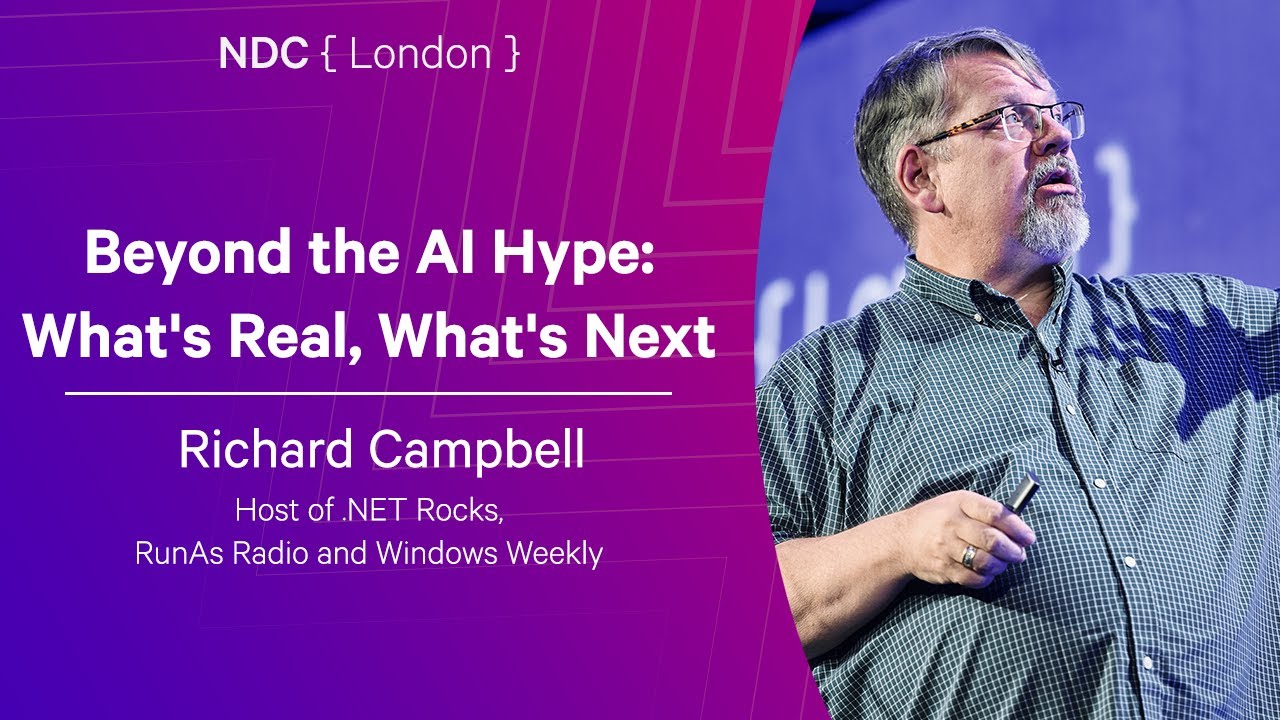
📸 Beyond the AI Hype: What's Real, What's Next - Richard Campbell - NDC London 2026
Beyond the LLM Hype: Specialized AI's Quiet Revolution
While large language models dominate the headlines, it's crucial to remember that AI is a vast field. News outlets like MIT News frequently highlight breakthroughs in highly specialized areas that often don't get the same viral attention but are profoundly impactful. Take, for instance, the MIT research on AI algorithms enabling tracking of vital white matter pathways in the brainstem. This isn't about writing poetry; it's about opening new windows into understanding neurological diseases.
For developers, this signifies a few things:
- Niche Opportunities: The AI market isn't just for general-purpose chat applications. There's immense value in specialized AI that solves specific, hard problems in fields like healthcare, materials science, environmental monitoring, and advanced manufacturing. These often require deep domain knowledge but offer significant impact and less crowded competitive landscapes.
- Diverse Skill Sets: Focusing solely on LLMs means you might miss out on developing expertise in areas like computer vision for medical imaging, reinforcement learning for robotics, or graph neural networks for drug discovery. These fields require different toolkits and problem-solving approaches.
- Hardware & Edge AI: Many specialized AI applications, especially in areas like robotics or IoT, demand efficient models that can run on constrained hardware at the edge, not just in massive data centers. This brings challenges and opportunities in model quantization, optimization, and embedded systems development.
So, while it's tempting to chase the latest LLM trend, don't forget to look at the quiet revolutions happening elsewhere. These are often where truly innovative and impactful applications are being built, far from the general-purpose AI arms race.
What I Actually Think About This
Honestly, the current state of AI is a wild ride. On one hand, it's incredibly exciting. The sheer power and versatility of modern models are pushing boundaries we only dreamed of a few years ago. The developer tools are getting better, the communities are thriving, and the potential for positive impact across almost every industry is immense.
On the other hand, the hype is often deafening. We're seeing a lot of 'AI washing' – slapping AI on everything to make it sound cutting-edge. There's also a significant risk of over-reliance on black-box models without fully understanding their limitations or ethical implications. The regulatory landscape is a mess right now, with different regions trying to figure out how to govern something that's evolving faster than legislation can keep up. This creates a challenging environment for developers trying to build compliant, ethical, and robust systems.
My take? Don't get swept away by the loudest voices. Focus on understanding the fundamentals: data quality, model evaluation, prompt engineering, and crucially, the ethical implications of what you're building. Experiment with the new models, absolutely, but always ask: "What problem am I actually solving? Is AI the best tool for this? And how can I ensure this solution is fair, transparent, and responsible?" The developers who master this blend of technical prowess and ethical foresight are the ones who will truly shape the future, not just react to it.
Wrapping It Up: Stay Curious, Stay Critical
The AI news cycle isn't slowing down anytime soon. For developers, navigating this deluge means more than just reading headlines. It's about understanding the underlying technological shifts, recognizing the ethical and regulatory challenges, and spotting the niche opportunities beyond the mainstream hype.
So, keep experimenting, keep learning, and most importantly, keep applying a critical lens to everything you read and build. The future of AI isn't just being built by the tech giants; it's being shaped by every developer who chooses to engage with it thoughtfully and responsibly.
댓글
댓글 쓰기